
Historical Context and Regional Significance
The Singin Hinny is deeply embedded in the social fabric of the North East of England. Historically, these cakes were a staple of the high tea and supper tables in the mining villages of Northumberland and County Durham. Unlike the modern, industrialized baking processes that rely on temperature-controlled ovens, the traditional Singin Hinny is a product of the cast-iron griddle—or "girdle"—which was a standard fixture on the coal-fired ranges of the era.

The etymology of the name provides a glimpse into the vernacular of the region. In the local dialect, "hinny" is an affectionate term of endearment, synonymous with "honey" or "dear," frequently used in the same cultural lexicon as "pet." The "singin" component of the name refers to the audible phenomenon that occurs during the cooking process. When the moist, fat-rich dough contacts the high-heat surface of a seasoned cast-iron griddle, the moisture in the butter and lard creates a distinct, rhythmic hissing or "singing" sound. Folklore suggests that the name was popularized by local cooks who would appease hungry children waiting for their meal by telling them that the cakes were not yet ready because they were still "singin’, hinny."

Traditional Preparation Methods
The defining characteristic that separates the Singin Hinny from its culinary cousins, such as the Welsh cake or the standard drop scone, is its fat content and its traditional form. Authentic recipes mandate the use of both butter and lard in equal measure. This inclusion of lard is not merely a matter of flavor, but a technical requirement that provides the specific crumb structure and moisture retention necessary for a cake that is cooked rapidly over direct heat.

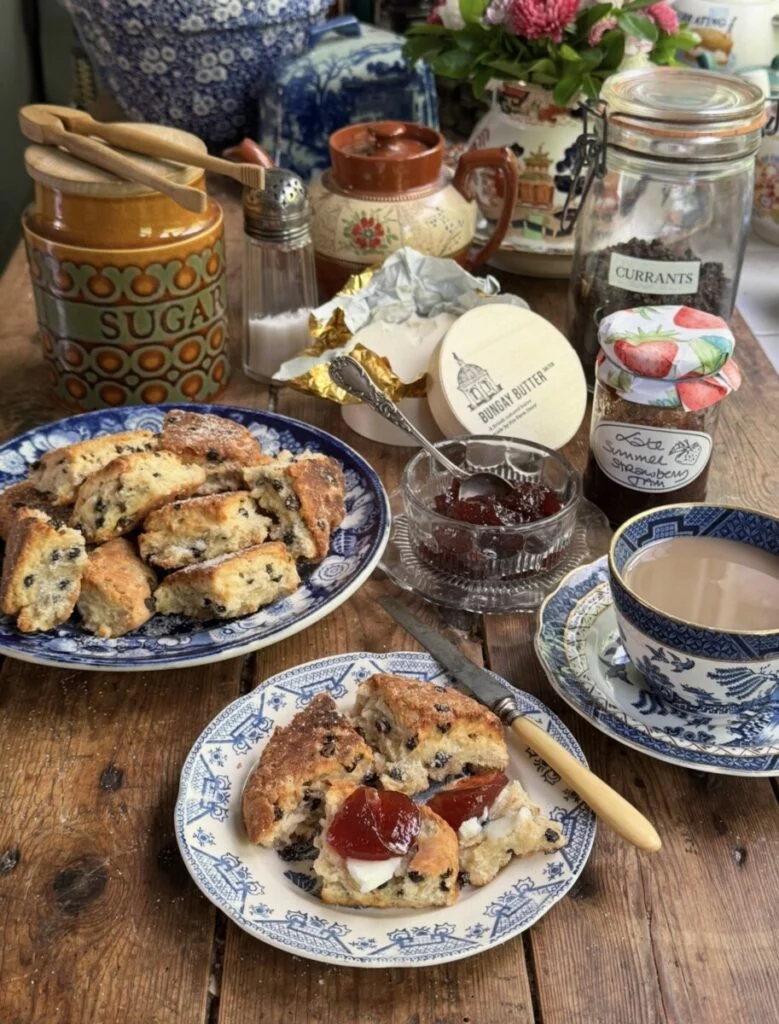
In traditional practice, the dough is not cut into individual, uniform discs as one might see in commercial bakeries. Instead, the dough is rolled into large, thick rounds, roughly the size of a tea plate. These rounds are placed onto the hot griddle and marked into quarters before they are fully set. Once the underside is golden and the dough has risen, the rounds are flipped using specialized wooden implements known as "Singin Hinny hands." These wooden tongs allowed cooks to handle the cakes without scorching their hands on the hot metal surface of the griddle. Once finished, the cake is broken into four distinct wedges, traditionally split while warm and served with a generous layer of butter and fruit jam.

Comparative Culinary Analysis
While the Singin Hinny shares a lineage with other regional griddle-baked goods, there are notable deviations. The Welsh cake, for instance, is typically rolled thinner and cut into smaller, circular shapes, often featuring a dusting of caster sugar on the exterior. The Singin Hinny is characterized by a more rustic, substantial profile.

From a nutritional perspective, the traditional Singin Hinny is a calorie-dense food, historically serving as a necessary energy source for workers in physically demanding industries. A typical serving, which consists of one wedge, contains approximately 128 calories. The composition is heavily weighted toward fats and carbohydrates, with roughly 6 grams of fat and 16 grams of carbohydrates per serving. This macro-nutrient profile was ideal for the dietary requirements of the mid-to-late 19th-century laborer, providing sustained caloric release during long shifts.

The Preservation of Regional Foodways
The survival of the Singin Hinny in modern kitchens is largely attributed to the efforts of heritage culinary advocates who emphasize the importance of using traditional equipment. The preference for using an aged, seasoned griddle—often passed down through generations—is considered essential for achieving the correct Maillard reaction on the surface of the dough.

Academic researchers in the field of regional dialect and social history, such as those at Newcastle University’s Digital Engineering and Technology Centre for Education, have highlighted how food names like "Singin Hinny" serve as living repositories for linguistic history. These names are not merely identifiers but cultural markers that connect modern consumers to the specific socioeconomic conditions of the Victorian and Edwardian eras in the North East.

Modern Implications and Consumption
In the current gastronomic landscape, the Singin Hinny is increasingly featured in regional tourism and heritage-focused culinary establishments. The National Trust and other cultural preservation bodies have begun to include these recipes in their programming, recognizing that the preparation of traditional cakes is a form of intangible cultural heritage.

The decline of the coal-fired range in domestic homes initially threatened the survival of such recipes. However, the adaptation of the technique for modern stove-top cast-iron pans has allowed the practice to continue. Food historians argue that the continued popularity of these cakes is not merely a matter of nostalgia, but a response to a desire for "slow food" that emphasizes quality ingredients and time-honored techniques.

The process of making Singin Hinnies remains an inherently communal act. Given the time required to properly heat a griddle and monitor the cooking process, it is a recipe that resists the convenience-focused trends of the 21st century. It requires the baker to remain attentive to the sound of the "singing" dough, reinforcing the connection between the cook, the equipment, and the final product.

Future Outlook
As the culinary world continues to explore the roots of British regional cooking, the Singin Hinny stands as a prime example of how simple, accessible ingredients—flour, fat, dried fruit, and a leavening agent—can be elevated through specific, location-based techniques. The ongoing documentation of these recipes by local historians and culinary authors ensures that the terminology and the technical nuances of the process remain accessible to future generations.

Furthermore, the integration of these recipes into broader discussions about regional identity suggests that the Singin Hinny will continue to be a staple of Northern English culture. By maintaining the distinction between the traditional, large-round preparation and the modern, small-disc variety, enthusiasts are ensuring that the historical integrity of this North East classic is preserved. Whether served as a mid-afternoon treat with tea or as a hearty accompaniment to a meal, the Singin Hinny remains a resilient and delicious piece of English history, "singing" as loudly today as it did a century ago.
